Articles by Author

The summer grill party is one of the most beloved of summer gastronomic experiences. On the Fourth of July we fire up the grill, people gather round impatiently, and on go the hamburgers, the hot dogs, the pork spareribs, the chicken breasts, the steaks. But why not take your grilling game up a notch this year?
More from Zester Daily:
» Grilled mussels make a go-to appetizer
» Fire up the grill this summer
Taking on a challenge can mean grilling something you don’t usually try, working with a theme, or grilling something big that needs attention and then to be carved, such as a whole half turkey breast on the bone with its skin. There’s an amazing taste if you’ve never tried. It comes off the grill and you slice it like a big ham. One could go the non-simple direction, such as stuffed roll-ups of veal scallopini or spit-roasted meat.
For a themed meal, grill something from a particular cuisine, or paired foods, or something historical, or foods of the same color or cut, or mixed grills. In the recipes below the theme is three kinds of fish steaks and three kinds of fresh herbs. Choose three kinds of firm fleshed fish steak and pair them with a fresh herb for grilling. Here are three that work.
Grilled swordfish with fresh orange juice and fresh thyme
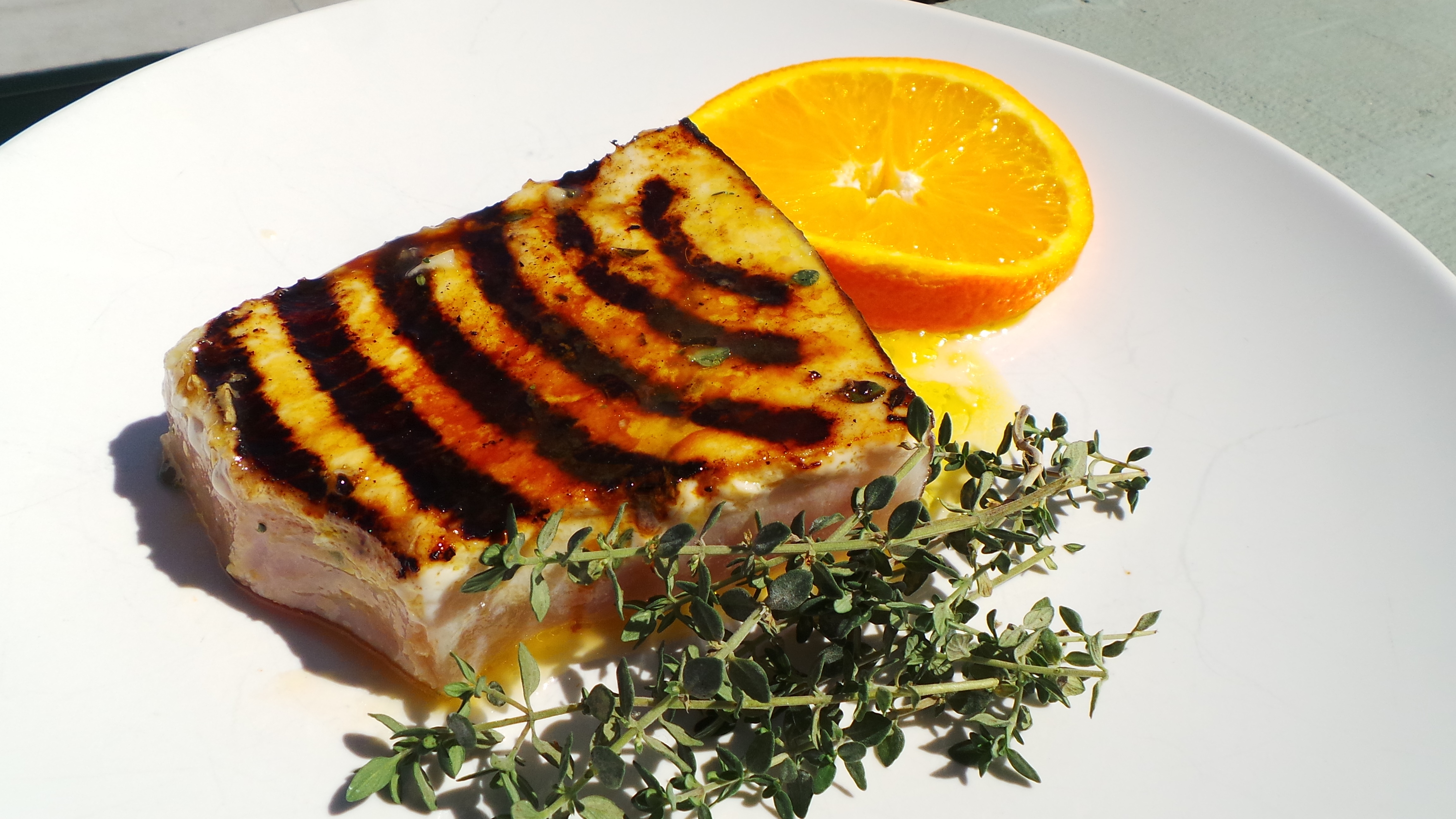
Grilled swordfish in fresh orange juice and thyme. Credit: Copyright 2016 Clifford A. Wright
This preparation is inspired by the way they would cook swordfish in Sicily. Swordfish is very popular in Sicily as they are found in the Straits of Messina and elsewhere around Sicily. The firm flesh of swordfish is perfect for grilling.
Prep and cooking time: 1 1/4 hours
Yield: 2 servings
Ingredients
1/4 cup extra virgin olive oil
Juice of 2 oranges
1 bay leaf, crumbled
1 garlic clove, finely chopped
Two 5-ounce swordfish steaks, 3/4 inch thick
3 tablespoons fresh thyme and thyme sprigs for garnish
Salt and freshly ground black pepper to taste
Directions
1. Prepare a hot charcoal fire or preheat a gas grill on high for 20 minutes.
2. In a ceramic or glass baking pan, swish the olive oil, orange juice, bay leaf, and garlic until mixed. Place the swordfish steaks in the marinade and coat with the thyme and salt and pepper and leave for 1 to 2 hours.
3. Grill the swordfish on the hottest part of the grill and grill until almost springy to the touch, 6 to 8 minutes in all, basting with the leftover marinade and turning carefully only once. Remove from the grill and serve.
Grilled fish with oregano, chile and olive oil
If there is one thing I miss since I moved to California, it’s bluefish, which we can’t get here. Bluefish is a dark-fleshed Atlantic fish when raw that is excellent grilled over a hot fire for a few minutes. When the “blues are running” as they say in New England or Long Island, grills come out and people make all kinds of things with bluefish: bluefish balls, bluefish fritters, bluefish pate, bluefish grill. If you’re elsewhere in the country, then you’ll want to use mackerel, bonito, yellowtail, mahimahi, or angelshark. Note in the recipe that you are using fillets, not steaks, and the fillet needs its skin on.
Prep and cooking time: 25 minutes
Yield: 4 servings
Ingredients
1/2 cup extra virgin olive oil
3 garlic cloves, mashed to a paste in a mortar
4 tablespoons finely chopped fresh oregano leaves
1 dried red chile, crumbled
Salt and freshly ground black pepper to taste
1 1/2 pounds bluefish or bonito fillets (about 3/4 inch thick)
Directions
1. Prepare a hot charcoal fire or preheat the gas grill on high for 15 minutes.
2. Lightly brush the grill with some olive oil. Stir together the remaining olive oil, garlic, oregano, chile, salt and pepper. Coat the bluefish with this mixture and lay skin side down on the grill.
3. Grill for 5 to 6 minutes while basting occasionally. Carefully flip the fish with a spatula and grill another 5 to 6 minutes, basting some more. Remove to a platter and serve.
Grilled salmon with tomato relish and mint
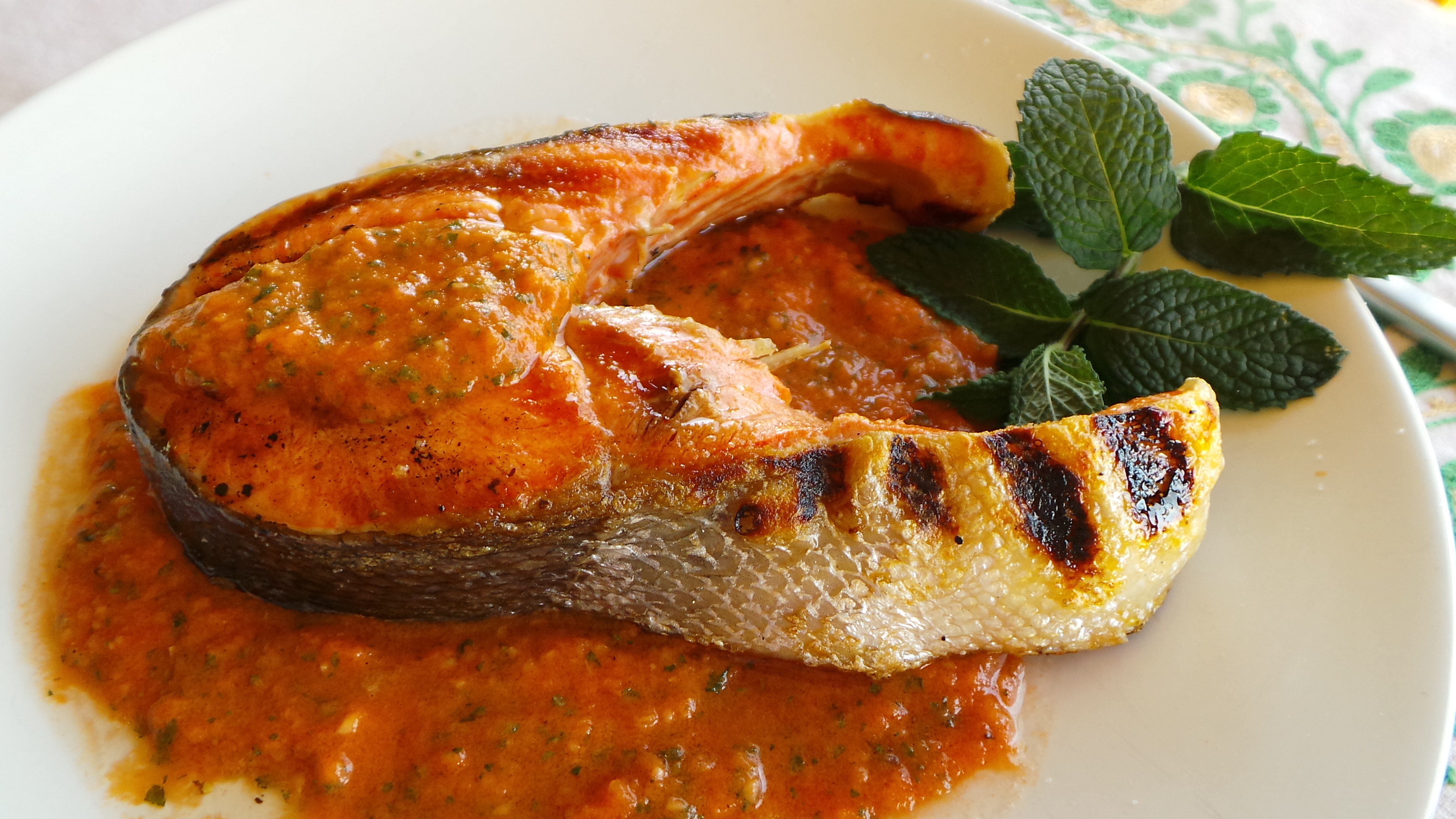
Grilled salmon with tomato relish and mint. Credit: Copyright 2016 Clifford A. Wright
The grilled salmon gets a treatment of salsa cruda, a raw sauce made of tomato, garlic and mint that can be made quickly in a food processor, which whips it into a froth very quickly. Serve the sauce on the side or spooned on top of the salmon.
Prep and cooking time: 30 minutes
Yield: 4 servings
Ingredients
6 ripe plum tomatoes, peeled, seeded, and drained of water
1/2 cup loosely-packed fresh mint leaves
2 garlic cloves
1/4 cup extra virgin olive oil
Salt and freshly ground black pepper to taste
1 1/2 pounds salmon fillet, in 4 pieces
Directions
1. Preheat a gas grill on high for 20 minutes or preheat a broiler or prepare a charcoal fire.
2. Place the tomatoes, mint leaves, garlic, and olive oil in the food processor and run until the salsa is frothy, 30 to 45 seconds. Season with salt and pepper and stir.
3. Season the salmon with oil, salt, and pepper on both sides and place skin side down on the grill. After 4 to 5 minutes, flip with a spatula and grill for another 3 to 5 minutes depending on the thickness of the fish. Serve immediately with the salsa.
Main photo: Grilled fish with oregano, chile and olive oil. Credit: Copyright 2016 Clifford A. Wright

In the springtime in Sicily a simply named dish reveals an explosion of flavor that belies its satisfying complexity. It is a dish special with spring vegetables — fava, peas, scallions and artichokes — and called frittedda (or fritedda).
In western Sicily, where frittedda was born, it is served as a grape ‘u pitittu, a Sicilian expression that means “a mouth-opener,” a culinary concept much closer to a Middle Eastern meze than an Italian antipasto. Pino Correnti, a leading Sicilian gastronome, believes that the name of this preparation comes from the Latin frigere, because it is prepared in a large frying pan.
The young artichokes needed for this dish can be hard to find. They are very tender and have not yet developed chokes. Because this dish is affected by the age and size of the vegetables, you will have to judge for yourself the right cooking time and how much salt, pepper and nutmeg you want to use, so keep tasting. This is a good time to use a very good quality estate-bottled extra virgin olive oil from Sicily.
This is most definitely a labor-intensive preparation. However, it tastes so good and can last so long to be served successively as antipasti and side dishes that a Sicilian cook never shies away from the work. It is a time to grab a glass of wine and with a friend or lover shuck the pods of fava and peas.

Frittedda. Credit: Copyright 2016 Clifford A. Wright
Spring Vegetable Frittedda
Prep time: About 1 hour
Cook time: Between 1 hour and 1 hour, 40 minutes
Total time: About 2 hours, 45 minutes
Yield: 6 to 8 servings
Ingredients
1 pound fresh peas, shelled (from about 2 1/2 pounds of pods)
2 pounds fresh fava beans, shelled (from about 5 pounds of pods)
10 young artichokes, each not more than 3 inches long (if you use older artichokes, with fully developed bracts and chokes, cook them longer in Step 2)
Juice from 1 lemon
1/2 cup extra virgin olive oil
1/2 pound scallions, white part only, finely chopped
Salt and freshly ground black pepper to taste
Freshly grated nutmeg
4 large fresh mint leaves, finely chopped
1 teaspoon red wine vinegar
4 teaspoons sugar
Directions
1. Rinse the peas and the fava beans and set aside. Trim the artichokes, quarter or halve, and leave them in cold water acidulated with the lemon juice until they are all prepared. In a large sauté pan (preferably a 14-inch sauté pan), heat the olive over medium-low heat, then cook, stirring, the scallions until soft, about 3 minutes.
2. Add the artichokes and cook for 5 minutes longer (15 minutes if they are fully developed globe artichokes), then add 2/3 cup hot water. Bring to a boil and simmer for 5 minutes. Add the peas and fava beans. Season to taste with salt, pepper and nutmeg. Cover and simmer, stirring occasionally, for 20 minutes.
3. Moisten the vegetables with more hot water if they look like they are drying out. Cook another 20 to 40 minutes or until tender; keep checking. Stir the mint, vinegar and sugar together and then pour over the vegetables while still hot. Transfer to a serving platter or bowl and let it reach room temperature before serving.
Fritedda with spring vegetables. Credit: Copyright 2016 Clifford A. Wright

Kale, Dandelion And Mustard Greens: 3 Star Attractions
by: Clifford A. Wright
in: Vegetables w/recipe
Although vegetables — especially dark leafy greens — are often treated as a side dish, they also can be served as an appetizer; as a bed for other foods; a dish on their own if made in quantity; or just cold as a kind of tapas.
More from Zester Daily:
» Brussels sprouts so good they'll convert haters
The attribute I like most about dark leafy greens, perhaps excepting spinach, is that they are rugged vegetables that can handle a variety of cooking methods including long cooking times.
These three simple recipes each result in a surprisingly delicious dish, but also in three quite appropriate appetizers for a follow-up dish the next day should you have leftovers. The recipes for the kale and the dandelion are Italian-style, sweet-and-sour preparations, which I find work particularly well (as the Italians discovered long ago) with bitter greens.
Black kale and vinegar
Kale is a bitter cruciferous plant and the so-called black kale, also known as Russian or Tuscan kale, is a particular cultivar that has very dark green, oak-like and crinkly leaves. The following is an Italian method of cooking, and it also makes the preparation very nice served at room temperature.
Prep and cooking time: 45 minutes
Yield: 2 to 3 side dish servings
Ingredients
1 tablespoon extra virgin olive oil
2 garlic cloves, finely chopped
One 1/8-inch-thick slice pancetta, cut into strips
10 ounces Russian or black kale, rinsed
1 tablespoon red wine vinegar
1 teaspoon sugar
Salt and freshly ground black pepper
Directions
1. In a sauté pan, heat the olive oil with the garlic and pancetta over medium-high heat, stirring, and once the pancetta is slightly crispy in about 4 minutes, add the kale.
2. Cover and cook on low until the kale is somewhat tender, about 30 minutes. Add the vinegar with the sugar dissolved in it to the pan, cover, and continue cooking 10 minutes.
3. Season with salt and pepper and serve warm or at room temperature.
Sweet and sour dandelion

Sweet and sour dandelion. Credit: Copyright 2016 Clifford A. Wright
In Italian they would call this kind of dish agrodolce or sweet and sour. The sweetness added to the bitter taste of dandelion is a contrast that many gourmets swoon over.
Prep and cooking time: 20 minutes
Yield: 2 side dish servings
Ingredients
1/4 cup extra virgin olive oil
1/2 ounce pancetta, diced small or cut into thin strips
2 large garlic cloves, finely chopped
Four 1/4-inch thick slices onion
1 bunch dandelion (about 3/4 pound), bottom quarter of stems removed, washed
3 tablespoons chopped fresh mint
Salt and freshly ground black pepper to taste
2 teaspoons sugar
2 tablespoons red wine vinegar
Directions
1. In a sauté pan, heat the olive oil over medium heat with the pancetta, garlic and onion and cook until softened, stirring, about 5 minutes.
2. Add the dandelion and mint and cook until they wilt, tossing frequently. Season with salt and pepper. Meanwhile, dissolve the sugar in the vinegar then pour over the dandelion and cook until evaporated, about 3 minutes.
3. Serve warm or at room temperature.
Drowned mustard greens

Drowned mustard greens. Credit: Copyright 2016 Clifford A. Wright
This Sicilian-inspired recipe is derived from a recipe originally for broccoli, but it works spectacularly with mustard greens. The Sicilians call this kind of dish affucati, ”drowned,” because it’s smothered in wine. It’s terrific as a room-temperature appetizer the next day too. If serving the next day as a room temperature antipasto, let the Parmigiano-Reggiano melt and then drizzle some olive oil to serve.
Prep and cooking time: 30 minutes
Yield: 4 side dish servings
Ingredients
1/4 cup extra virgin olive oil
1 onion, coarsely chopped
4 garlic cloves, finely chopped
4 salted anchovy fillets, rinsed
1 pound mustard greens, heavier stems removed and discarded, leaves washed and shredded
3/4 cup dry red wine
8 imported black olives, pitted and chopped
Salt and freshly ground black pepper to taste
3 tablespoons freshly grated Parmigiano-Reggiano cheese
Directions
1. In a flameproof casserole, heat the olive oil over medium-high heat, then cook the onion and garlic until soft, stirring constantly so the garlic doesn’t burn, 3 to 4 minutes. Add the anchovies and once they have melted add the shredded mustard greens, cover, and cook until they wilt, about 5 minutes.
2. Pour the red wine into the sauce with the olives, salt and pepper. Cover again, reduce the heat to medium and cook 15 minutes. Transfer to a serving platter with a slotted spoon and sprinkle on the Parmigiano.
Main photo: Black kale with vinegar. Credit: Copyright 2016 Clifford A. Wright

Italian-Americans will tell you flat out that linguine accompanies seafood. Well, at least Long Island Italian-Americans will tell you that. My grandfather, who was from a small village 85 kilometers east of Naples, immigrated to New York in the early 20th century and lived there the rest of his life. He took my mother fishing in Sheepshead Bay in Brooklyn and they brought home bluefish, porgies, flounder or fluke on the subway back to their Manhattan tenement. Many different preparations would be made, but if it were to be a pasta dish, the pasta was linguine.
More from Zester Daily:
» Avoid American pasta mistakes with 'Sauces and Shapes'
» 5-minute pasta sauce made with fresh tomatoes
The array of pastas you will encounter in a market aisle look innumerable. There are many more pastas, and perhaps you haven’t thought what you could do with them. This is a wonderful time to start experimenting. The Italians are said to have invented about 700 pasta shapes. This includes specialty pastas made for certain occasions. I still have my box of Menucci brand 1776-1976 pasta made for the U.S. Bicentennial and am still trying to figure out if I should put it in a living room shadow box or the kitchen pantry.
One problem faced by the cook is what sauce for what pasta. Books have been written on this, but let’s keep it simple here. In the 1960s when I first started working in restaurants, I began cooking. I was mostly influenced by the cooking of my Italian grandfather and by my mom who made Italian food at home. I was also greatly influenced by my travels to Italy, by the restaurants I worked in, which were staffed by Italians, and by the cookbooks of Ada Boni, a famous mid-20th century Italian author.
The matching of pasta shapes with sauces is something of an art. There is usually some logic to it, but not always. Tubular pastas such as cut ziti or rigatoni are great in baked dishes and with thick ragouts that can get stuck in the tubes. Seashell pasta and chickpeas make sense because the shells capture the peas. Wide, flat pastas such as fettuccine and pappardelle are nice with sauces that cling to their wide surfaces.
If there was one thing I learned from my grandfather it was that seafood always went with linguine, the flat filiform pasta about 2 millimeters wide. Here are three great linguine and seafood recipes that would have made my grandfather swoon:
Linguine alla Pescatore

Linguine with swordfish, shrimp and oysters. Credit: Copyright 2016 Clifford A. Wright
Preparation and cooking time: 2 hours
Yield: 6 servings
Linguine alla pescatore means linguine in the style of the fishermen. I’ve always doubted these dishes are actual fishermen’s dishes as implied by the name. The various “pescatore” dishes in Italy always struck me as trattoria dishes. In any case, this is a simple preparation with flavors that bely the simplicity. The secret, besides the freshest seafood, is the marinade the seafood sits in made with saffron, chile flakes, garlic and parsley. Once you’re ready to serve, the cooking happens quickly.
Ingredients
¾ pound swordfish, cut into ½-inch cubes
12 oysters, shucked, with their liquid
½ pound medium shrimp, shelled
4 salted anchovy fillets, rinsed
¼ cup chopped fresh parsley
3 large garlic cloves, finely chopped
Pinch of saffron, crumbled slightly
½ teaspoon red chile flakes
Freshly ground black pepper to taste
6 tablespoons extra virgin olive oil, divided
Salt to taste
3/4 pound linguine
Directions
1. In a bowl, toss the swordfish, oysters, shrimp, anchovy fillets, parsley, garlic, saffron, chile flakes, black pepper and 4 tablespoons of olive oil together. Leave to marinate for 2 hours.
2. Bring a large pot of water to a rapid boil, salt abundantly, then cook the pasta until al dente. Drain without rinsing.
3. In a large sauté pan, heat the remaining 2 tablespoons olive oil over high heat, then cook the seafood mixture, stirring frequently, seasoning with salt, until cooked through, about 5 minutes. Transfer the pasta to the pan and toss several times, letting the pasta cook and absorb some of the juices. Serve immediately.
Linguine With Salmon, Basil and Mint

Linguine with salmon, basil and mint. Credit: Copyright 2016 Clifford A. Wright
Preparation and cooking time: 20 minutes
Yield: 4 servings
This is a subtle dish and since everyone loves salmon it is delightful with the fresh herbs.
Ingredients
1/2 pound linguine
3 tablespoons extra virgin olive oil
1 pound salmon, cut into bite-size pieces
1 small onion, finely chopped
2 garlic cloves, finely chopped
1/4 cup finely chopped fresh basil
2 tablespoons finely chopped fresh mint
Salt and freshly ground black pepper to taste
Juice from 1/2 lemon
Directions
1. Bring a large pot of water to a rapid boil, salt abundantly, then cook the pasta until al dente. Drain without rinsing.
2. Meanwhile, in a sauté pan, heat the olive oil over medium-high heat, then cook the salmon, onion, garlic, basil and mint until the salmon is cooked through, about 5 minutes. Season with salt and pepper and drizzle the lemon juice on the fish. Transfer the fish and pasta to a serving bowl, toss well and serve immediately without cheese.
Linguine With Tuna and Green Beans
Preparation and cooking time: 20 minutes
Yield: 4 to 6 servings
When my children and the children of my friends were little, before their palates became adventurous, we adults who cooked for both adults and young children faced a dilemma. The adults didn’t want boring “kid food” and the children were finicky, all to a different degree. I refused to slave over two separate meals, so I relied on this quick preparation that fit the gustatory bill, pleasing all kinds of palates.
Ingredients
1/4 cup extra virgin olive oil
1 garlic clove, finely chopped
12 ounces tuna, canned in water and drained
1/2 cup loosely-packed fresh oregano leaves, finely chopped
Salt and freshly ground black pepper to taste
1 pound linguine
1/2 pound green beans, trimmed and cut into 1/2-inch lengths
Directions
1. In a flameproof casserole large enough to contain all the pasta, heat the olive oil over medium-high heat with the garlic, tuna, and oregano. Once it begins to sizzle, cook for 2 minutes then remove from the heat. Season with salt and pepper.
2. Meanwhile, bring a large pot of water to a rapid boil, salt abundantly, then cook the pasta until al dente. Drain without rinsing. Transfer the pasta and green beans to the casserole and toss with the tuna. Serve immediately.
Main photo: Linguine With Tuna and Green Beans. Credit: Copyright 2016 Clifford A. Wright

In traditional Mediterranean cooking, dried beans are typical winter foods that are often combined with winter greens and root vegetables such as Swiss chard, spinach, squash, potatoes, sweet potatoes and others.
More on Zester Daily:
» What beginning cooks don’t know about Indian dal
There is a delight in these kinds of dishes not only because they’re delicious, but they are satisfying and healthy too. These three are only examples of what you can do with “beans and greens.”
To devise your own combination, start with a dried legume and then consider its color and match that with an appropriate root vegetable (color also considered) and an appropriate green.
So, for example, red kidney beans, white potatoes, and kale or lentils, beet greens and yams and so on all cooked for beautiful winter main courses or side dishes. If serving as a main course, you should double these recipes.
Beans and Greens: beans, sweet potato and chard

Beans and Greens: beans, sweet potato and chard. Credit: Copyright 2015 Clifford A. Wright
Prep time: 6 to 8 hours with bean soak or 10 minutes without
Cook time: 45 minutes
Yield: 2 to 4 servings
Ingredients
1/4 cup (about 2 ounces) dried red kidney beans, soaked in water for 6 to 8 hours, drained
1 bay leaf
6 ounces sweet potato, peeled and diced
3 ounces winter squash, peeled and diced
1/4 pound Swiss chard leaves, chopped coarsely
2 tablespoons extra virgin olive oil
1 1/2 ounces finely chopped onion
1/8 teaspoon cumin seeds
Salt to taste
Directions
1. Place the beans in a large pot with the bay leaf and cover with cold water. Bring to a boil over high heat and cook 25 minutes. Check to see if the beans are tender with a little bite to them. If not, cook longer. Add the sweet potato, squash and Swiss chard, stir, and cook until they are all tender, about 20 minutes. Drain.
2. Meanwhile, in a sauté pan, heat the olive oil over medium heat then cook, stirring, the onion and cumin until the onion is translucent, about 5 minutes. Add the drained beans and greens to the pan, mix well, season with salt, cook 1 minute then serve.
Beans and Greens: fava, eggplant and frisee

Beans and Greens: fava, eggplant and frisee. Credit: Copyright 2016 Clifford A. Wright
Prep time: 6 to 8 hours with bean soak or 10 minutes without
Cook time: 50 minutes
Yield: 2 to 4 servings
Ingredients
1/4 cup (about 2 ounces) dried yellow fava beans, soaked in water 6 to 8 hours, drained
1 cup extra virgin olive oil
5 ounces eggplant, peeled and diced
1 1/2 ounces finely chopped onion
1 large garlic clove, finely chopped
1/4 pound frisee, chopped
1 1/2 ounces arugula, chopped
2 tablespoons fresh mint, chopped
Salt to taste
Directions
1. Place the fava beans in a pot and cover with cold water. Bring to boil over high heat and cook until tender, about 40 minutes (check for tenderness and cook longer if necessary).
2. Meanwhile, in a skillet heat the olive oil over medium-high heat then cook, turning occasionally, the eggplant until golden brown, about 6 minutes. Remove the eggplant with a slotted spoon or skimmer and set aside. Discard all but 2 tablespoons of the oil. Reduce the heat to medium.
3. Add the onion and garlic to the pan and cook, stirring, until the onion is translucent, about 5 minutes. Add the frisee, arugula, and mint to the pan and cook, stirring, until wilted, about 8 minutes. Add the fava beans and cook, tossing with a little salt, for a minute. Serve hot.
Beans and Greens: chickpeas, spinach and potato

Beans and Greens: chickpeas, spinach and potato. Credit: Copyright 2016 Clifford A. Wright
Prep time: 6 to 8 hours with bean soak or 10 minutes without
Cook time: 45 minutes
Yield: 2 to 4 servings
Ingredients
1/4 cup (about 2 ounces) dried chickpeas, soaked in water for 6 to 8 hours, drained
5 ounces boiling potato, such as Yukon gold, white or red potato, peeled and diced
6 ounces spinach leaves, chopped
3 tablespoons extra virgin olive oil
1 small leek, white part only, split lengthwise, washed well and finely chopped
1 large garlic clove, finely chopped
1/2 stalk celery, finely chopped
1 tablespoon finely chopped fresh tarragon
Salt and freshly ground black pepper to taste.
Directions
1. Place the chickpeas in pot and cover with cold water. Bring to a boil over high heat and cook for 15 minutes (taste one and if it is quite hard cook another 20 minutes) then add the potato and cook until the potato has disintegrated a bit and the chickpeas are tender, about another 25 minutes. Add the spinach and cook until it is wilted, about 2 minutes. Drain and set aside.
2. In a sauté pan, heat the olive oil over medium heat then cook, stirring, the leek, garlic and celery until soft, about 5 minutes. Add the tarragon and cook until it wilts in a minute. Add the drained chickpeas and spinach, and toss well with some salt and pepper then serve hot.
Main photo: Three lusty winter beans and greens. Credit: Copyright 2016 Clifford A. Wright

Given how easy it is to make harīsa, the ubiquitous chile paste of North Africa, I’ve never had much use for those inferior tubes of the stuff. Harīsa is the most important condiment used in Algerian and Tunisian cooking, and you need to make this recipe and keep it in the refrigerator before attempting any other Algerian or Tunisian recipe you might have in my or others’ recipes.
More from Zester Daily:
It’s hard to believe that so essential a condiment could evolve only after the introduction of the New World capsicum after Columbus’ voyages. It’s thought that the chile entered North Africa by way of the Spanish presidios that dotted the coast in the 16th century or came up from West Africa overland from the Portuguese holdings there.
Harīsa comes from the Arabic word for “to break into pieces,” which is done by pounding hot chiles in a mortar, although today a food processor can be used. This famous hot chile paste is also found in the cooking of Libya, and even in western Sicily where cùscusu is made. In Tunisia it would be prepared fresh at home. The simplest recipe is merely a paste of red chile and salt that is covered in olive oil and stored.
Harīsa is sold in tubes by both Tunisian and French firms. The Tunisian one is better, but neither can compare to your own freshly made from this recipe.
I first became intrigued with making harīsa from a preparation made by Mouldi Hadiji, my Arabic teacher more than 30 years ago. I concocted this version, based on a Berber-style one I had in Djerba, from a recipe description given to me by a merchant in the market in Tunis, who unfortunately provided measurements that could last me a century (calling for 50 pounds of chile).

Tlitlu bi’l-Lahm (fresh pasta pieces with lamb in spicy harīsa sauce). Credit: Copyright 2016 Clifford A. Wright
Some cooks also use mint, onions or olive oil in their harīsa. You also don’t have to use the exact dried chiles I call for, but at least one should be quite piquant.
Be careful when handling hot chiles, making sure that you do not put your fingers near your eyes, nose or mouth, or you will regret it. Wash your hands well with soap and water after handling chiles. After you make your first harīsa, with all the modern conveniences, I hope you can appreciate what exacting work this was, making it in the traditional mortar — 50 pounds of the stuff!
Harīsa
Prep time: 1 1/4 hours
Yield: 1 cup
Ingredients
2 ounces dried Guajillo chiles
2 ounces dried Anaheim chiles
5 garlic cloves, peeled
2 tablespoons water
2 tablespoons extra virgin olive oil
1/2 teaspoon freshly ground caraway seeds
1/2 teaspoon freshly ground coriander seeds
1 1/2 teaspoons salt
Extra virgin olive oil for topping off
Directions
1. Soak the chiles in tepid water to cover until softened, 1 hour. Drain and remove the stems and seeds. Place in a blender or food processor with the garlic, water and olive oil and process until smooth, stopping occasionally to scrape down the sides.
2. Transfer the mixture to a small bowl and stir in the caraway, coriander and salt. Store in a jar and top off, covering the surface of the paste with a layer of olive oil. Whenever the paste is used, you must always top off with olive oil making sure no paste is exposed to air, otherwise it will spoil.
Variation: To make a hot harīsa, use 4 ounces dried Guajillo chiles and 1/2 ounce dried de Arbol peppers.
Note: To make ṣālṣa al-harīsa, used as an accompaniment to grilled meats, stir together 2 teaspoons harīsa, 3 tablespoons olive oil, 2 tablespoons water and 1 tablespoon finely chopped fresh parsley leaves.
Main photo: Harisa. Credit: Copyright 2016 Clifford A. Wright