
Articles in World

If shakshuka is not yet on your food radar, then it soon will be. And be prepared to fall head over heels for this homely Tunisian favorite that may well be the region’s most delicious onomatopoeic egg dish.
Even though it sounds as if it ought to mean “all shook up” à la Elvis, the word shakshuka actually means “all mixed up,” a subtle distinction. Its charm is based on a trio of basic ingredients: tomatoes, fried or poached eggs and some form of chili pepper. Sounds simple, but as in all such deceptively easy recipes, the devil is in the detail.
More from Zester Daily
» Don’t buy the myth. Here’s how eggs make a healthy diet
» 5 reasons to add Tunisian olive oil to your shopping list
In Israel, the cult of shakshuka has especially taken wing, becoming as ubiquitous as hummus and falafel. Introduced to the country by Jewish immigrants from North Africa, it is now found on cafe and restaurant menus throughout the country, served from dawn till dusk.
The mother of all shakshuka dishes is served at the eponymous Doctor Shakshuka in Jaffa along with a range of Libyan favorites, but on Tel-Aviv’s Ben Yehuda Street you can find small, hole-in-the-wall cafes that serve nothing but shakshuka. Choose the fiery heat level, specify the degree of softness of your egg yolk and select from a range of extra toppings and ingredients such as fresh herbs, eggplant, feta, merguez sausage, tahini or tofu.
A daring “green” shakshuka — made with leeks and spinach in a creamy sauce with no tomatoes — is fast becoming popular. A shakshuka baguette I encountered, however, was to my mind an innovation too far — in looks, like something you’d find in a medical textbook; in taste, much the same.
A rose by any other name might smell as sweet, but to shakshuka mavens the dish would just not have same the exotic appeal if it was simply called baked eggs in tomato sauce.
Shakshuka: Debating recipe tips
The tomatoes in this dish need to be really ripe and packed with flavor. Peeling is preferable but optional. Canned tomatoes are acceptable, though they don’t have quite the same textural quality. On the other hand, some prefer it this way.
Red peppers are sometimes fried with the tomatoes, although a strong, vocal faction contends they should be chargrilled separately and added to the sauce once the latter is cooked. Some avoid them altogether.
Use very fresh spices, or the sauce will taste flat. Add them at the start and fry gently in olive oil before adding the tomatoes. Popular spices include cumin, caraway and black pepper. Paprika, chili pepper, cayenne, harissa or a similar fiery spice is the key. Garlic is optional but eminently desirable. Ditto onion. Or both.
The sauce on which the eggs will rest should not be too liquidy, so make sure you cook it until it largely evaporates.
Use eggs at room temperature, because a cold egg will cook unevenly. The whites take longer to cook than the yolks, so timing is tricky. Some cooks cover the pan to solve the problem, but that tends to overcook the yolk. Still, some folk run a mile from a runny one. Others separate the eggs, cooking the whites till set before adding the yolks. Personally, I feel this lacks the proper aesthetic.
If you want to add extra ingredients, do so either just before adding the eggs or at the same time.
Shakshuka can be cooked in either a large communal skillet to dish out as required or in individual dishes so you can serve them in the pan in which they were cooked.
Mop up your shakshuka with good bread. No argument.
Shakshuka: A starting point
The recipe is intended as a guide. Regard shakshuka as a free-wheeling dish dependent on personal preferences and ingredient availability.
Prep time: 10 minutes
Cook time: 50 minutes
Total time: 1 hour
Yield: 4 servings
Ingredients
4 tablespoons olive oil
1 onion, finely sliced
1 red pepper, diced
4 garlic cloves, finely chopped
2 teaspoons sweet paprika
1/2 teaspoon cumin seeds
1/2 to 1 teaspoon cayenne pepper
2 pounds tinned tomatoes (or ripe tomatoes in season)
2 teaspoons sugar (optional, depending on the flavor of the tomatoes)
1 tablespoon lemon juice
4 to 8 eggs, depending on size/hunger
Salt and pepper to taste
Small bunch of fresh coriander or parsley, roughly chopped
Directions
Heat the oil in a large, lidded frying pan over medium heat. Add the onion and cook until golden, then add the pepper. Fry until both are soft, then stir in the garlic, paprika, cumin seeds and cayenne pepper and cook for another couple of minutes.
Add the tomatoes and sugar, if using. Bring to a boil, then turn down the heat and simmer for 30 minutes. Taste and season, adding more cayenne if you prefer it spicier.
Make 4 to 8 shallow indentations in the sauce, and break in the eggs. Season them lightly with salt and pepper, then turn the heat down as low as possible, cover and cook for about 10 minutes until the eggs are just set.
Sprinkle with coriander or parsley and serve.
Green Shakshuka
This breaks the shakshuka rules — it has no tomato! — but makes an excellent brunch or breakfast dish.
Prep time: 5 minutes
Cook time: 15 minutes
Total time: 20 minutes
Yield: 2 to 3 servings
Ingredients
1 large leek, sliced
2 to 3 tablespoons olive oil or butter
3 garlic cloves, finely chopped
1 teaspoon sweet paprika or chili flakes
6 cups spinach or kale, chopped
1/2 cup sour cream
A little freshly grated nutmeg to taste
6 eggs
1/4 pound feta or goats’ cheese
Directions
Fry the leek in the butter or oil in a wide frying pan for about 10 minutes. Add the garlic, and when the aroma rises, add the paprika or chili flakes, then stir in the spinach until it starts to wilt.
Add the sour cream, nutmeg, salt and pepper and stir to mix well.
Make shallow dips in the sauce, and break an egg into each one. Cook for a few minutes or until the eggs are done to your liking. Cover the pan briefly if you think appropriate.
Sprinkle with the cheese and serve immediately.
Main image: Shakshuka is a Tunisian dish that can be eaten at any meal of the day. Credit: Copyright 2016 Clarissa Hyman

I’ve lived in Italy off and on since the 1970s, eating my way up and down the peninsula, shopping the markets, raising the vegetables in my own gardens, prepping and cooking the food, studying the history and meeting the home cooks and chefs who carry the treasures of the Italian table in their heads, hearts and hands. I’ve learned a lot, in short, about Italian cooking. But almost everything I know, everything I’ve learned, ultimately traces back to one source — Marcella Hazan.
Her first book, “The Classic Italian Cook Book,” published by Knopf in 1973 and acquired by me a few years later as a gift from an erstwhile husband when we moved to Rome, truly opened the doors of my kitchen to Italian cooking. I have been grateful ever since. I consult that book and her many others to this day, often uncovering unexpected tips, ideas and information. Now I have a new treasure in my Marcella library — “Ingredienti” — her husband, Victor’s, tribute to his wife of nearly 60 years, who died in 2013.
A true Italian kitchen, in Marcella’s words
This invaluable little book is based on Marcella’s notebooks, discovered by Victor after her death and assembled by him into usable form. A caution: It is not a cookbook, though any number of cooking tips are scattered throughout. It is, in fact, a series of intelligent, well-informed essays on critical ingredients for an Italian kitchen, from “Produce” (artichokes, arugula, etc. ) to “The Essential Pantry” (pasta, of course, olive oil, Parmigiano, etc.) to “Salumi” (all the cured meats — prosciutto, guanciale, pancetta, and, as they say in Italian, via dicendo).

“Ingredienti” by Marcella and Victor Hazan. Credit: Copyright 2016 book cover courtesy of Scribner
It’s an open secret in the food world that Victor Hazan was the defining voice in his wife’s long and remarkable career. While the brilliant ideas, sensible advice and enormous range of recipes Marcella produced all came from her inspirations and her own kitchens, it was Victor who developed the clear, comprehensive prose that distinguished her seven cookbooks and countless magazine articles. Throughout her career, she was a pervasive influence on America’s understanding of Italian food, yet she never had a restaurant, never starred in a television show and almost never appeared in public to give a talk or do a demonstration. What a different world she lived in, but she ruled that world for 40 years and continues, for many of us, to dominate it to this day.
An inspiring force

Marcella Hazan at a cooking demonstration. Credit: Copyright 2016 Victor Hazan
I met Marcella in the 1970s after “The Classic Italian Cook Book” was published. In fact, the first food story I ever wrote was an interview with the Hazans at their cooking school in Bologna, Italy, in a hotel across from the train station that was also headquarters for the Bologna division of Weight Watchers International (providing a memorable lead sentence for my story). Eight or 10 students were in the class, one of whom was planning to open a “northern Italian” restaurant somewhere in the upper Midwest and had come to take a weeklong course to understand what she was getting into. Another was a man who claimed to detest olive oil. “I don’t know what he’s doing in an Italian cooking class,” Marcella murmured, barely sotto voce, in her inimitably gravelly voice.
The menu for the class was simple, though some techniques were not. Students struggled to master shaping tortellini, the devilishly difficult little hat-shaped filled pasta that is the pride of Bologna’s sfogline, or pasta-makers. But there was also a traditional arrosto di maiale al latte, pork loin braised in milk, a surprisingly simple dish, flavored with nothing but salt and pepper, rich and succulent. A dish first described by Artusi, the Fanny Farmer of 19th-century Italian cooking, it was introduced to Americans by Marcella — and it deserves to be revived.
That was not my only encounter with the Hazans. In fact, I remember almost every time I spent with them simply because from each encounter, I took away a piece of invaluable knowledge. But one, in particular, stands out: In the late 1980s, when I was working as a food journalist in New York, Marcella called to invite me to dinner. “I want to show you something about pasta,” she said. The next evening, in the Hazans’ comfortable East Side apartment, she presented her dinner guests with two plates of pasta, identically dressed very simply with butter, a grating of Parmigiano Reggiano and a light sprinkle of herbs, nothing to interfere with the flavors of the pasta. One plate of tagliatelle had been made entirely by hand, rolled out on a board “until the pasta is almost paper thin and transparent,” as she says in that first book. The tagliatelle on the second plate were what you and I might call handmade, but rolled through a hand-cranked pasta machine. In the machine, as she wrote, “something happens to its composition … that gives the dough an ever so slightly slippery texture.” The words are Victor’s, but the sentiment, precise and to the point, is Marcella’s to the core.
And you know what? She was absolutely right!
Arrosto di maiale al latte (Pork Loin Braised in Milk)
This recipe was published in Marcella Hazan’s “The Classic Italian Cook Book” (Knopf 1973)
Yield: For 6 persons
Ingredients
2 tablespoons butter
2 tablespoons vegetable oil
2 pounds pork loin, in one piece, with some fat on it, secretly tied
1 teaspoon salt
Freshly ground pepper, 3 or 4 twists of the mill
2 1/2 cups milk
Directions
Heat the butter and oil over medium-high heat in a casserole large enough to just contain the pork. When the butter foam subsides, add the meat, fat side facing down. Brown thoroughly on all sides, lowering the heat if the butter starts to turn dark brown.
Add the salt, pepper and milk. (Add the milk slowly, otherwise it may boil over.) Shortly after the milk comes to a boil, turn the heat down to medium, cover, but not tightly, with the lid partly askew, and cook slowly for about 1 1/2 to 2 hours, until the meat is easily pierced by a fork. Turn and baste the meat from time to time, and, if necessary, add a little more milk. By the time the meat is cooked, the milk should have coagulated into small nut-brown clusters. If it is still pale in color, uncover the pot, raise the heat to high, and cook briskly until it darkens.
Remove the meat to a cutting board and allow to cool off slightly for a few minutes. Remove the trussing string, carve into slices 3/8-inch thick, and arrange them on a warm platter. Draw off most of the fat from the pot with a spoon and discard, being careful not to toss any of the coagulated milk clusters. Taste and correct for salt. (There may be as much as 1 to 1 1/2 cups of fat to be removed.) Add 2 or 3 tablespoons of warm water, turn the heat on high, and boil away the water while scraping and loosening all the cooking residue in the pot. Spoon the sauce over the sliced pork and serve immediately.
Main photo: Marcella and Victor Hazan. Credit: Copyright 2016 Barbara Banks
There is prosciutto and then there is culatello.
Proscuitto is ubiquitous. It’s draped over melon or paired with figs or mozzarella in restaurants everywhere. You can buy imported Proscuitto di Parma at Whole Foods at $31 a pound for a bone-in leg or on Amazon for $15.
Massimo Bottura serves culatello. At Osteria Francescana, his Michelin three-star restaurant in Modena that topped the 50 Best Restaurants for 2016, it appears as an appetizer, paired with Campanine apples, mustard and crunchy “gnocco” bread.
And not just any culatello. Chef Bottura procures his culatello exclusively from Massimo Spigaroli’s Antica Corte Pallavicina, an inn and working farm one hour’s drive from Modena. You’ll find that same culatello at Alain Ducasse’s Sporting Club in Montecarlo and Bombana in Hong Kong. But nowhere in the United States. The closest you’ll get is Zibello fiocco (culatello salami) for $40 a pound.
Prosciutto versus culatello

Vertical Tasting of Spigaroli culatello at Antica Corte Pallavicina. Credit: Copyright 2016 John Pleshette
Culatello (“little backside” in Italian) is the fillet of the pig’s hind leg from which prosciutto is cured. Both are salted and left to sit for two months, which draws out the blood and kills bacteria. The process predates the Romans, and except for the introduction of nitrites, which further inhibit bacterial growth, it hasn’t changed much since. Proscuitto is then hung in a cool place for anywhere from nine months to two years, while culatello is encased in a pig’s or cow’s bladder and hung for 18 to 27 months.
All proscuitti are not created equal. Only a dozen designations are protected by the EU and stamped PDO or PGI, which guarantees they come from a particular region and, more important, are cured only with sea salt and no nitrites. All are produced in northern Italy. They vary in taste and texture depending on the terroir and the pigs. San Daniele, with its dark color and sweet flavor, is from Fruili. Parma pigs are fed whey from Parmigiano Reggiano, lending Proscuitto di Parma a nuttier flavor.
Culatello is more high-maintenance. Spigaroli’s black pigs are kissing cousins to the acorn-fed pigs that give us Jamon Ibérico. It cures throughout the cold damp winters in the Po Valley just south of Cremona. The difference between prosciutto and culatello is subtle, but profound.
A tasting

Fourteenth-century charm meets 21st-century gastronomy in the dining room at Antica Corte Pallavicina, the inn and working farm on the River Po. Credit: Copyright 2016 Antica Corte Pallavicina
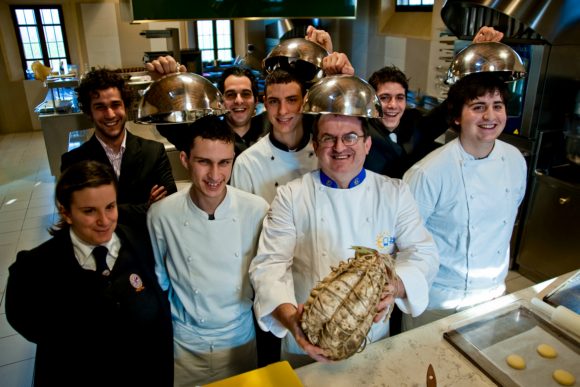
In the sun-filled dining room at Antica Corte Pallavicina, Spigaroli’s prized culatello is presented for a tasting beneath three celadon cloches. Each conceals pink-mahogany curtains of culatello. The first two, from white pigs, are aged, respectively, 18 and 27 months. The familiar salty-sweetness of prosciutto gives way to a leathery richness. The older culatello is nuttier. The black pig culatello is smokier, with black cherry notes and a velvety texture. Between pigs, we cleanse our palates with hunks of crusty country bread and glasses of Trebbiano, served with pickled vegetables and fiocco, the chewy-soft salami made from the trimmings and the fat.
More from Zester Daily:
» Tips and tales from Italy's top chef Massimo Bottura
» Top 19 European restaurants worth a trip
Antica Corte Pallavicina commands several acres close to the Po, encompassing Spigaroli’s restaurant, the hotel, a cooking school, a farm, a parmesan factory and culatello cellars. Al Cavallito Bianco, a more casual osteria, is run by Spigaroli’s brother Luciano. If you snag one of the six rooms, you can meet the pigs and tour the Parmigiano fattoria and culatello caves, which were built in 1320 by the marquesse di Pallavicina for precisely that purpose.
The Spigarolis’ great-grandfather went from a sharecropper at a nearby pintador belonging to Guiseppe Verdi to tenant farmer at Pallavicina. Their father was born there in 1916. But by 1990, when the sons purchased the property, it had fallen into ruins. The extensive restoration combines rustic charm with modern conveniences. The original, ox-sized fireplace dominates the dining room, where a wall of glass doors opens onto a trellised patio. A massive decommissioned steel stove functions as a serving station.
Going to the source

Spigaroli culatello ages in the cellars built in 1320 by the Marquesse di Pallavicina. Credit: Copyright 2016 John Pleshette
After consuming feather-light tortelli, stuffed with ricotta from Spigaroli cows and Spigaroli spinach — glistening with Spigaroli brown butter and showered with Spigaroli Parmigiano — we tour the caves, down a dungeon’s stairs to the dank cellar. The culatelli, white with mold, hang from the ceiling, encased in pigs’ bladders like ghostly chandeliers. Misty air wafts in from the Po. Such cellars are increasingly rare. The EU frowns on such conditions as potentially unsanitary. Because of that flavor-enhancing mold, the FDA forbids importing it to the United States. You’ll have to go to the source.
You’ll find yourself in food heaven. Emilia-Romana is Italy’s Burgundy; Bologna, its Lyon. You won’t find a better spaghetti carbonara than the one at Pizzeria delle Arte in Bologna, spiked with guanciale, creamy with Parmigiano and egg yolks the color of navel oranges. Massimo Bottura celebrates that same Reggiano in his Five Ages of Parmiagiano at Osteria Francescana.
Our last dinner, in Milan, we sit next to three Italian businessmen. “What brings you to Italy?” one wants to know.
“We came for the culatello.”
“Ah.” He smiles. He understands.
Main caption: Chef Massimo Spigaroli and his team show off their prized culatello. Credit: Copyright 2016 Antica Corte Pallavicina

A wave of new, summery drinks is taking over Korea. Marketed almost exclusively toward women, the fruit-flavored sojus and alcopops are low in alcohol, high in sugar and raise some interesting questions about how women are perceived and marketed to in a country that still has some of the worst gender-equality outcomes in the world.
Soju is similar to vodka, but with about half the alcohol content of most spirits. It is extremely popular in hard-drinking South Korea — especially among men. Keen to tap into the female market, soju makers have for years been lowering the alcohol content and experimenting with different, sweeter varieties to attract women.
Capturing the market

Grapefruit, apple, pomegranate, blueberry and citron are just some of the choices available in the new sojus and alcopops. Credit: Copyright 2016 Jo Turner
But it hasn’t really worked until last year, when soju maker Chum-churum started a revolution with Soonhari, a citron-flavored soju. Now, the country’s major soju producers, Chum-churum and Jinro, are falling over themselves putting out new versions of fruit-flavored drinks to capture the market. Grapefruit, apple, pomegranate, blueberry and citron are just some of the choices available. Most of them have between 11 and 14 percent alcohol, as opposed to the 17 to 21 percent in regular soju.
“I like the fruity soju,” says Kim Hyeon-seo, a clerk at a 7-Eleven in Ilsan, a city just north of Seoul. “It has more flavor than pure soju, and the alcohol level is lower than regular soju.” She says they sell a lot of flavored sojus, mostly to young women.
A sweeter flavor

Soju makers have rolled out a line of lighter, fruit-flavored drinks. Credit: Copyright 2016 Jo Turner
Lee Young-jin, the manager of Hanshin Pocha bar in Ilsan, says they sell plenty of the fruit sojus. “Before flavored soju, people just drank the regular soju,” Lee says. “We’d sell six cases of it a day. But with the new soju, we sell eight or nine cases.”
He says a table with three women will often put away eight or nine bottles of flavored soju, as opposed to only two or three of the regular kind.
Along with these fruity sojus are new alcoholic sodas like Brother Soda and Iseul Tok Tok. Both are 3 percent alcohol by volume, thanks to a white wine base, but you would never know from tasting them. Brother Soda tastes exactly like cream soda. Iseul Tok Tok tastes like “2%,” a popular peach-flavored soda in Korea. You can’t taste a hint of alcohol in either.
Lim Jongwoo, a waiter at Yaki Hwaro Galbe, says the sodas are almost entirely consumed by women. Lim says he doesn’t drink them, because “the alcohol level is very low.”
At a nearby table, Kang Yujin, 27, says, “I like the taste, its sweet flavor. Sometimes I drink regular soju, but mostly the flavored one.” She says that she’ll usually drink two bottles in one night.
Targeting the trendsetters

Soju, always popular among men in South Korea, is now making inroads among women, too. Credit: Copyright 2016 Jo Turner
Daniel Gray, who runs food tours of Korea and the food blog “Seoul Eats,” says the companies are marketing toward women because they “have most of the buying power in Korean society, and tend to make the trends and influence the market on what to buy.”
More from Zester Daily:
» Spaghetti in Seoul? A 'Fat Girl' tells you where to go
» South Korea's latest food craze: BBQ lamb skewers
Gray notes this isn’t the first time flavored sojus have been introduced — previous attempts over the last 10 years, including cucumber and green tea-flavored sojus, died quickly. He predicts that once the trend recedes, Korea will be left with only two fruit-flavored sojus, probably grapefruit and citron.
James Turnbull, an expat Briton who has written extensively about gender in Korea, thinks the advertising campaigns for the new sojus are overly “cutesy” and reinforce a trend in Korea called “aegyo,” where women try to be attractive to men by acting like young children. This contrasts with mainstream soju ads, which in the past decade, Turnbull says, have been emphasizing an extreme sexuality.
Park Solmin is a 23-year-old professional woman and is the exact target the soju makers have in mind. But she has a problem with how the ads reinforce a traditionally Korean view of gender. “They’re going to try to appear a very pure and weak image of a woman,” she says. “They’re trying to show it’s OK for those women who are trying to be very girlish, very typically weak.”
Park admits, though, that the flavored drinks do taste much better than traditional ones.
As a middle-aged man, Turnbull admits he’s hardly the target for these new drinks. But he also admits he likes them, and wonders why they only market to women. “I think a lot of guys like them, because (regular) soju tastes like crap,” he says.
Main photo: Soju makers in South Korea are targeting women with fruit-flavored drinks. Credit: Copyright 2016 Jo Turner
This story begins 20 years ago.
While researching my first book, “The Japanese Kitchen,” I met Tsuyoshi Iio, the fourth-generation president of Iio Jozo, a family-owned, small rice vinegar production company founded in 1893 in Kyoto Prefecture, Japan.
Iio Jozo is the most honest and respected rice vinegar producer in Japan. It’s not just the company’s exceptional tasting rice vinegar, but most important, its vinegar is safe to consume. Here’s what I mean.
Best rice vinegar
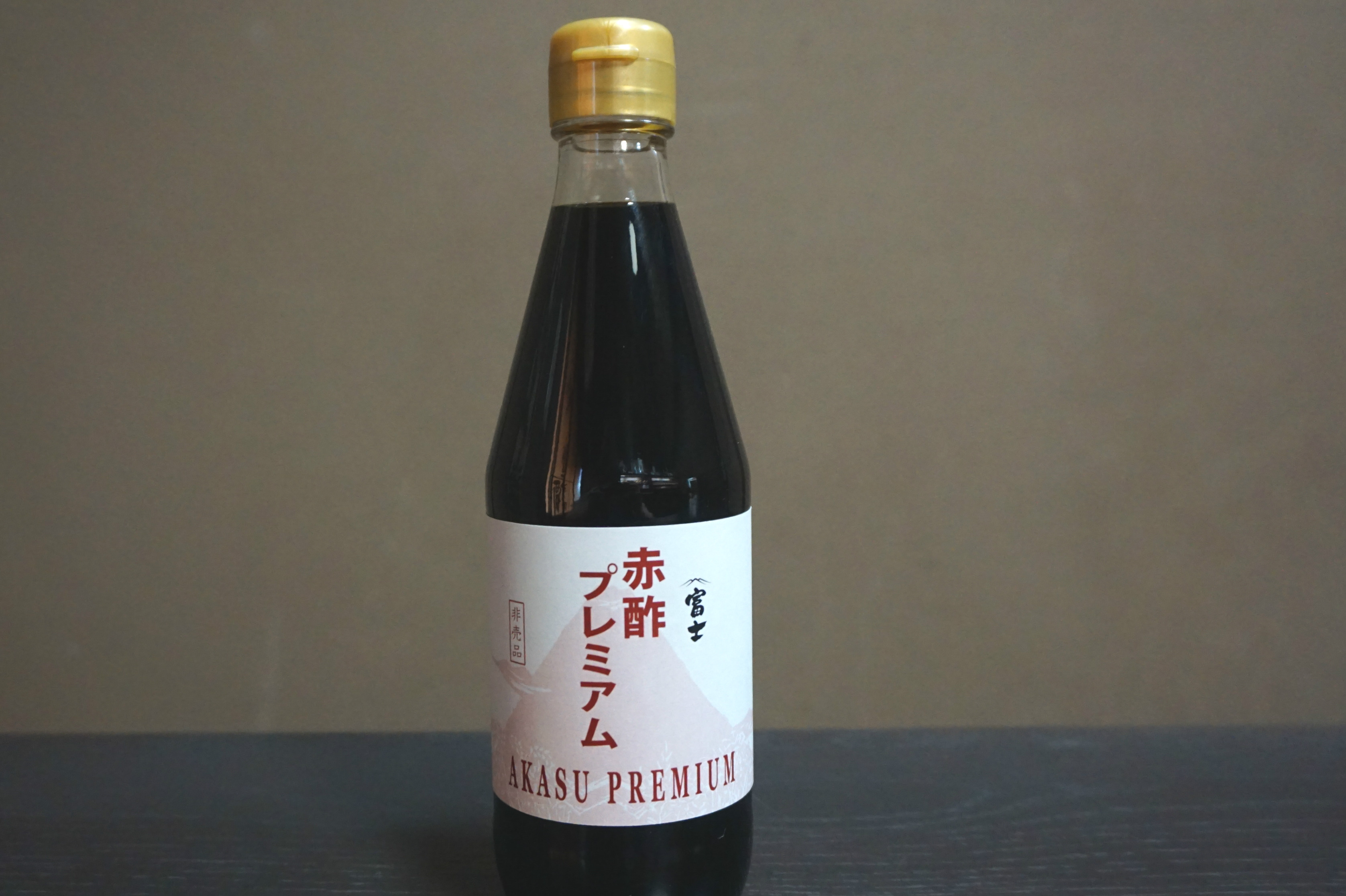
Iio Jozo’s Akasu, the best and only long-aged sake lees vinegar in Japan. Credit: Copyright 2016 Hiroko Shimbo
Tsuyoshi’s father, Terunosuke Iio, was a visionary president of the company. During the 1950s, Japan became caught up in rapid postwar economic development. The use of strong agricultural chemicals — to increase and speed up the production — became the norm. But soon tadpoles, wild insects and animals disappeared from rice paddies. Farmers suffered from mysterious diseases.
More from Zester Daily:
» Hang loose with poke, Hawaii's take on sushi
» A sushi just right for making at home
At that time, Terunosuke Iio read the Japanese translation of Rachel Carson’s “Silent Spring” and decided he wanted to use only organic rice in his vinegar production. But it took him two years to persuade enough farmers to agree to raise rice organically. All the farmers were aware of the toxic influence of chemicals, but most could not be persuaded to return to the labor intensive, chemical-free farming practices.
Today Iio Jozo Company is run by an energetic fifth-generation president, Akihiro Iio. It has been producing 3- to 5-year-aged Akasu for years. Recently the company began aging it up to 15 years, upon receiving a request from a sushi chef in Nagoya Prefecture.

Aji (horse mackerel) fresh, not aged, from Wakayama Prefecture. Aji is an oily fish, so the sushi is always topped with a mound of grated ginger and thinly sliced chives as a mouth refresher. But Chef Kimura hides the ginger and chives between the fish and sushi rice. He says, “Those condiments are unnecessary for our eyes. Our taste and texture sensors enjoy the harmony of the fish and the condiments only in our mouth.” Credit: Copyright 2016 Hiroko Shimbo
Aged fish
A complete, miraculous transition — this was my experience at Sushi Kimura, a tiny seven counter-seat sushi bar restaurant in Futako Tamagawa, just one hour from central Tokyo by train.
At this restaurant, Chef Koji Kimura has developed a special kind of nigiri sushi.
He uses fish that has been cured and aged — some up to 90 days. This aged fish does not spoil nor become stinky; it acquires much umami and a quite tender texture.
Chef Kimura discovered it almost by accident.
After opening his small restaurant, he waited for customers night after night, for weeks. The fresh fish he had purchased and prepared did not keep for long. “There were lots of waste,” he said.
Instead of giving up, Kimura was determined to find out how long he could age and improve the fish. Bleeding, salting, de-salting, shaving the surface, observing — every day for months his hard work brought him to a startling accomplishment. He successfully produced delicious, safe-to-eat fish through aging up to 90 days.

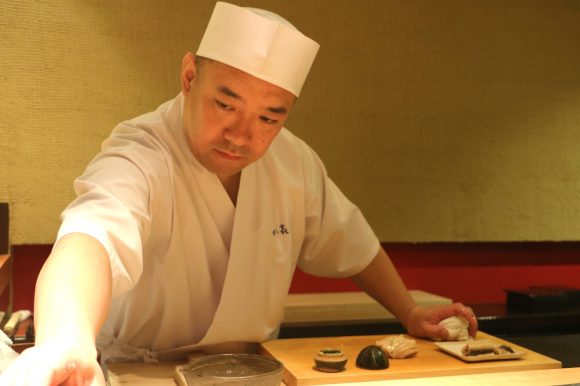
Chef Kimura proudly exhibits a bottle of Iio Jozo rice vinegar (left) behind his sushi counter. Credit: Copyright 2016 Hiroko Shimbo
In order to create the perfect match for such fish, Kimura cooks his rice to a rather firm texture and flavors it with Akasu (“red color-tinged rice vinegar”).
The use of Akasu in the preparation of sushi rice produces a distinctive, strong yeasty fragrance and taste, and a faint reddish brown color. Akasu was made from sake lees, the solids left over from fermenting rice to make sake; it was the vinegar used at the time of the invention of nigiri sushi in the city of Edo.
And, thus the marriage of two unique businesses — Kimura Sushi’s aged fish and Iio Jozo’s Akasu. Together they produce a new dining experience, one with deep historical roots.
A harmony of flavors
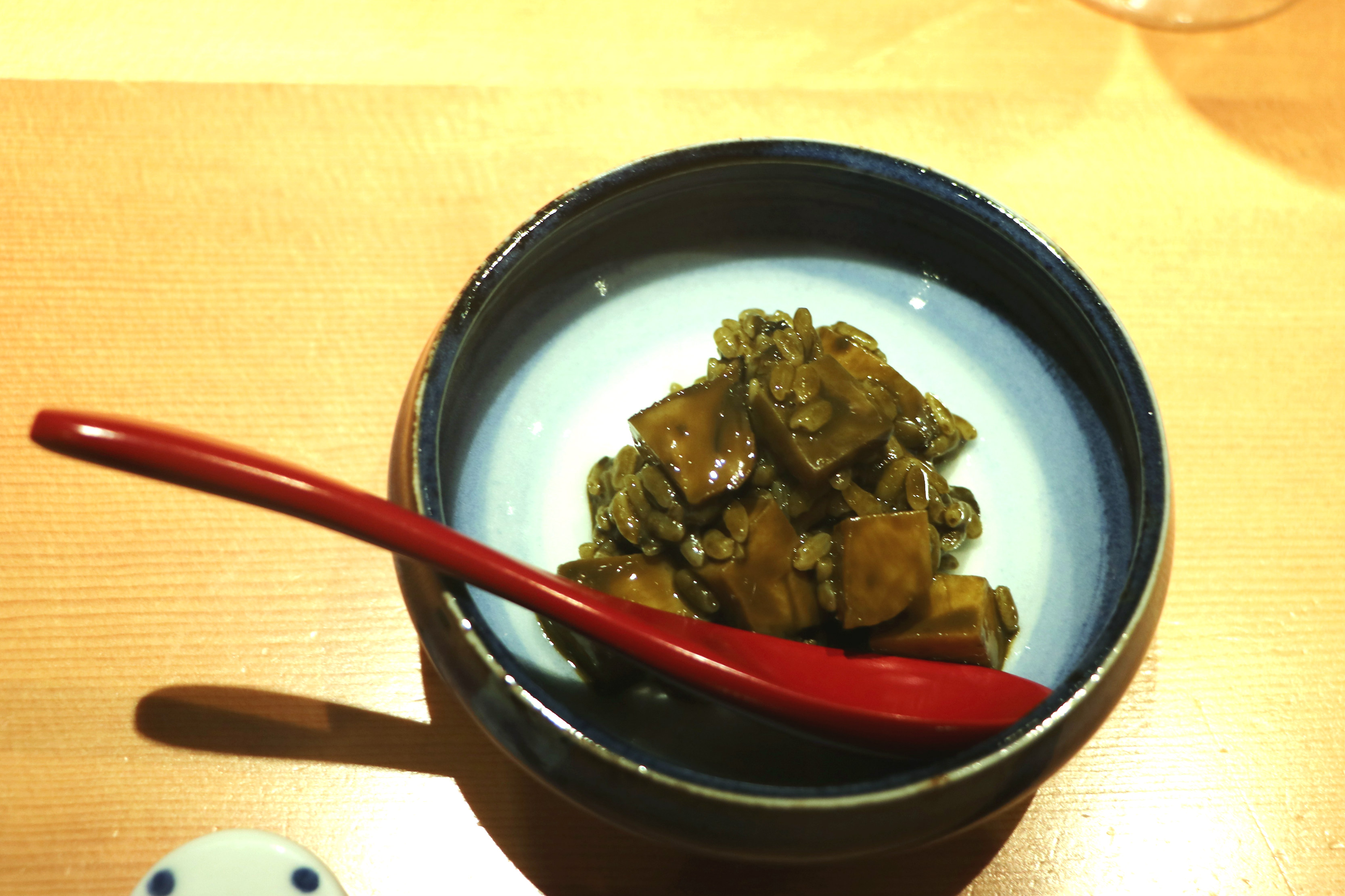
This appetizer before my sushi course is “abalone risotto.” It consists of sushi rice with tender-cooked cubed abalone flavored with a sauce made with abalone liver resulting in a creamy texture with a distinctive flavor and a hint of bitterness. Credit: Copyright 2016 Hiroko Shimbo
For my meal at Kimura Sushi, I began with 10-day aged shiro-amadai (white horsehead) on top of a small squeeze of sushi rice. It was tender and sweet with a surprising touch of firmness.
Fourteen-day aged kinme (alfonsino) was melting tender with umami that was further elevated by the Akasu. To my surprise, kinme loses two-thirds of its original weight during the aging process.
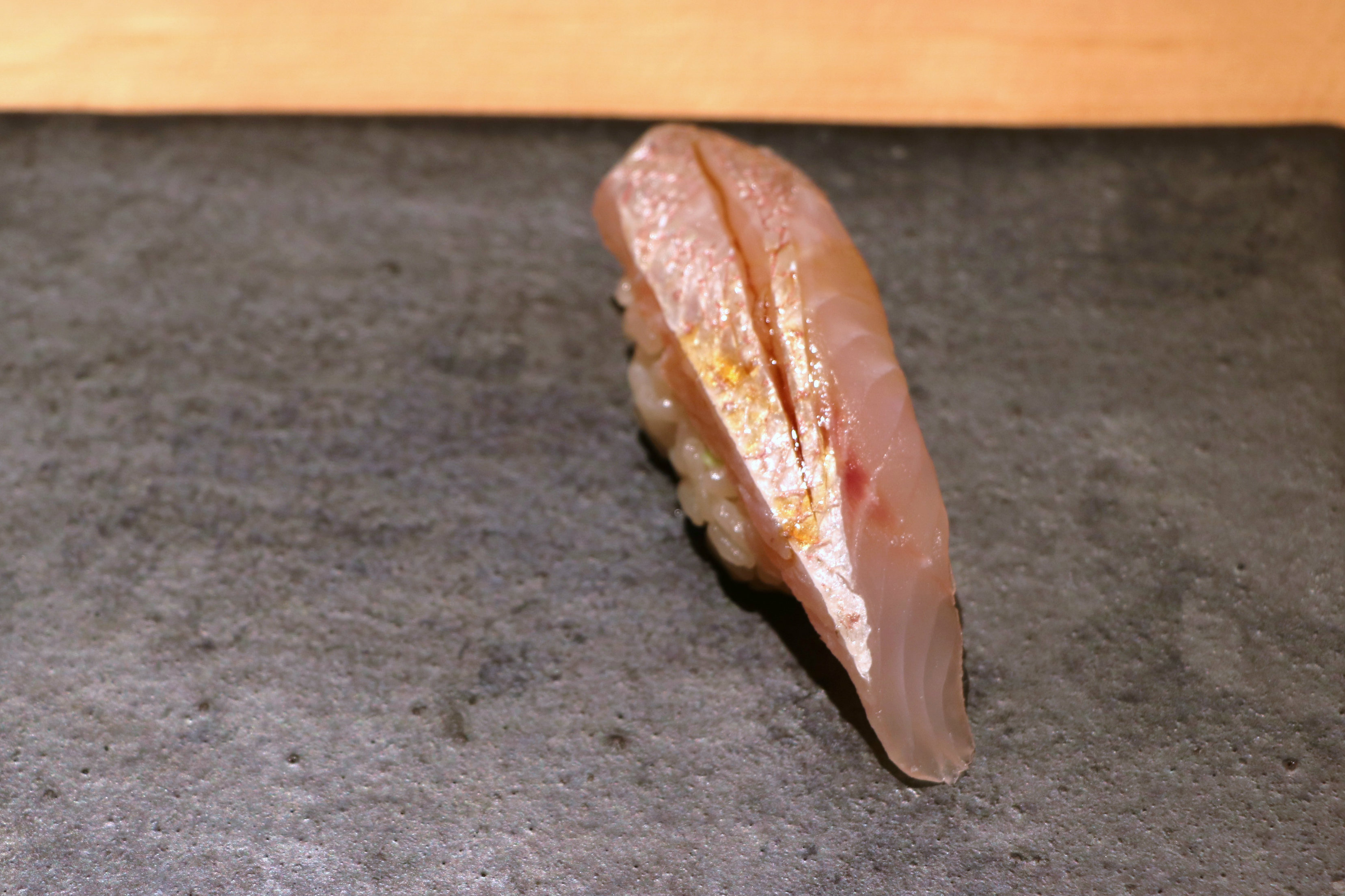
Fourteen-day aged kinme (alfonsino). Kinme is a very expensive fish in Japan that can not be wasted. Its white flesh is noted for its sweet and oily flavor. Chef Kimura’s aging process results in fish that is tender and creamy, but not broken down and mushy. Credit: Copyright 2016 Hiroko Shimbo
Aji (horse mackerel) from Wakayama Prefecture was fresh, crunchy and delicious. Tai snapper was lightly cured in kelp.
But the climax was unthinkable before my visit: 60-day aged makajiki (striped marlin).
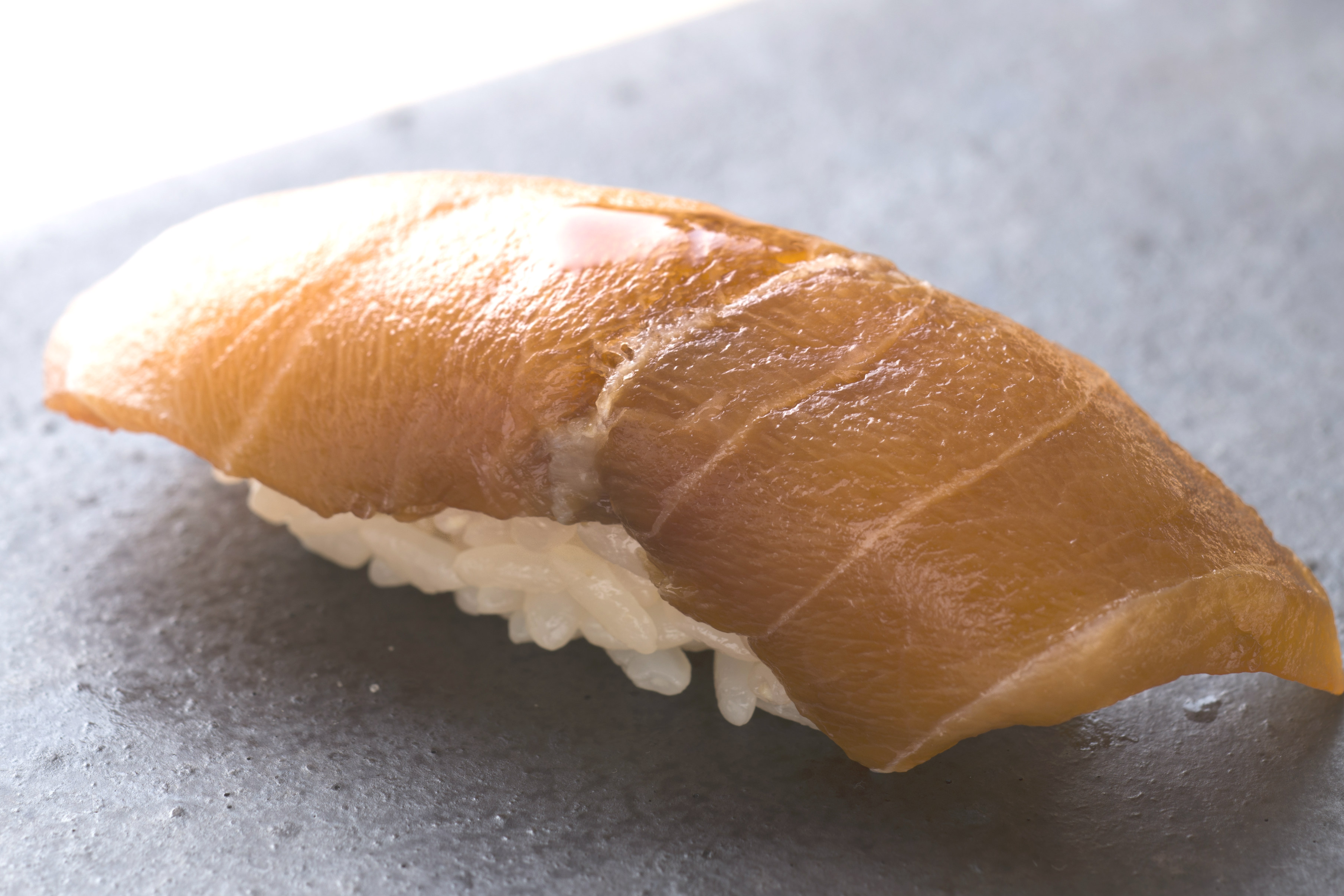
Chef Kimura’s 60-day cured makajiki (striped marlin) proved that properly aged fish can develop so many wonderful new and delicious flavors. Credit: Copyright 2016 Hiroko Shimbo
I closed my eyes to concentrate all of my senses on the fish. Caramel, coffee, cream, sweet … a miraculous harmony of flavors swept through my mouth. Aging matters — probably it’s much better for the fish than for me.
Main photo: Chef Koji Kimura enjoys conversation over the sushi counter with his regulars, but his demeanor becomes much more serious when he is crafting and presenting sushi to his customers. Credit: Copyright 2016 Hiroko Shimbo

Italy’s beautiful Lake Iseo is the venue for artist Christo’s latest project, “The Floating Piers,” a 52-foot-wide, 2.7-mile pathway on the water from the town of Sulzano to the Monte Isola island, continuing along pedestrian roads from Peschiera to Sensole, then reaching to San Paolo Island. The project runs through July 3.
Floating piers

Christo’s saffron-colored “The Floating Piers” connects islands and the mainland on Italy’s Lake Iseo. Credit: Wolfgang Volz Copyright 2016 Christo
The artist describes the sensation of strolling along the floating piers as “walking on the back of a whale” and, yes, it is a long walk indeed.
If you are lucky enough to experience this, you’ll probably be hungry after your walk. There are many osterias along the lakeside promenade where you can enjoy the traditional dish of manzo all’olio di Rovato, or Rovato beef in oil. (Rovato is a small town located in the Franciacorta hills, close to the lake.)
More from Zester Daily:
» An old chestnut: Traditional Italian desserts
» In Northern Italy, polenta commands center plate
At the time of the Republic of San Marco, the meat market in Rovato, in northern Italy, was the most important one on the route from Venice to Milan. Merchants coming from Liguria used to bring the typical products of their land, such as oil and anchovies, which are central to this beef dish.
The dish can be accurately dated to the second half of the 16th century, when the recipe was written down by a noblewoman, Donna Veronica Porcellaga. It has been a family recipe for five centuries, handed down from one generation to the next, so that each family has its own version. It consists of three basic ingredients: olive oil, anchovies and the lean meat called cappello del prete (priest’s hat), usually used for bollito misto. Garlic, bread crumbs and some vegetables are also added. According to experts, the trick is to sear the beef quickly on the sides so it cooks slowly and remains tender, keeping all the juices in.
Rovato beef reinvented

Vittorio Fusari’s version is served with broccoli, spinach, chicory, baguette-shaped polenta, green sauce, fresh anchovies and pressed olives. Credit: Copyright 2016 Masaka Zukurihara
Just like art, this 500-year-old recipe can be made in the traditional spirit — or it can be revisited with an innovative twist, as Christo does with his projects.
Three local top chefs have different takes on it.
Stefano Cerveri from Due Colombe in Borgonato di Cortefranca keeps alive the family tradition and remains faithful to Granma Elvira’s cooking, a classic version dated 1955 and enriched with a spoon of acacia honey.
Matteo Cocchetti from Dispensa Pani e Vini Franciacorta serves a slightly nontraditional dish, a beef filet cooked at low temperature with dried lake sardines and parsley sauce.
Finally, Vittorio Fusari, born and raised between the Franciacorta wineries, is a true philosopher when it comes to local cuisine. At magnificent Palazzo Lana Berlucchi, he serves an innovative version, vacuum-sealing the meat and slowly warming it up to 125 F, then taking off the packaging and slowly cooking it in his own extra virgin lemon-flavored olive oil at 150 F. The meat lies over a green bed made with broccoli, spinach and chicory, and served with baguette-shaped polenta, green sauce, fresh anchovies and pressed olives.
“I believe that a traditional recipe may be changed only if you respect it, know it well and love it,” says Fusari, “and that’s exactly the opposite of demolishing it.”
Manzo all’olio

Stefano Cerveri at Due Colombe uses his grandmother’s traditional recipe, which dates to 1955. Credit: Copyright 2016 Luigi Brozzi
Cooking Time: 3 1/2 hours
Total Time: 4 hours and 20 minutes
Yield: 4 Servings
Ingredients
3 pounds of lean meat
1 cup extra virgin olive oil
1 onion, finely chopped
9 tablespoons butter
3 anchovies in oil
1 carrot
6 fresh leaves of spinach
1 pound whole-grain wheat flour
3 garlic cloves
4 cups warm water
2 tablespoons cornstarch
Directions
1. Saute the anchovies in butter, adding the chopped onion and the garlic cloves.
2. Cut the meat long, making two pieces, and brown the pieces in the pan for 10 minutes. Add about 4 cups warm water and slow-cook the meat for at least three hours, removing the fat that comes to the surface.
3. Halfway through, add the oil. Mix a handful of cornstarch with a little water and add it to thicken the sauce.
4. Remove the meat and cut it into slices of about 3 inches. Strain the sauce into another saucepan, add the carrot and finely chopped spinach and, if necessary, a teaspoon of cornstarch to thicken further.
5. Serve accompanied by polenta or a steamed potato.
Main photo: Matteo Cocchetti’s innovative version uses lake sardine, beef filet slowly cooked and parsley sauce. Credit: Copyright 2016 Arianna Mora

For many people the arrival of vine-ripened tomatoes marks the beginning of summer. But for me, it’s the mounds of corn at our farmers market. With countless ways to enjoy corn, one of the most delicious is to use corn kernels in an Asian-style congee or rice porridge.
More from Zester Daily:
» Can't let go of summer? Tomato corn soup can help
» Seven international soups to slurp
Certainly the easiest way to enjoy corn is to strip off the husks and place the cobs into boiling water or onto a blazingly hot grill. Featured center stage, a bowl of freshly cooked corn on the cob is wonderful. But corn is also an able supporting player when the kernels are cut off the cob and added to salads, soups, stews and pasta.
Congee, the best kept secret of the Asian kitchen
A meal in itself, congee is Asian comfort food. Putting good use to leftover rice, the most basic congee is a stew of boiled rice. Many cuisines have made the dish their own by layering in flavor with combinations of stocks, fragrant oils, fresh and dried herbs, spices, vegetables, meat, poultry and seafood.
Congee comes in many consistencies. Some feature the broth as much as the rice. Other versions have very little liquid and the congee has a consistency similar to porridge.
Any rice varietal will work nicely to make congee. Short grain, long grain, white or brown rice, it doesn’t matter. When the cooked rice is added to a liquid over heat, the starches thicken to create a sauce. Water can be used as the liquid, but a home-made stock adds much more flavor.
My congee borrows the general technique but is not an attempt to create an authentic dish as prepared in the Philippines, China, South Korea, Thailand, Japan, Sri Lanka, Myanmar, Indonesia, Malaysia or Vietnam.
Because the starting point for congee is so flavor neutral, a variety of vegetables, seasonings and stocks can be added. A fine dice of carrots, green beans or broccoli works well, as does a shredding of kale, spinach or sorrel. Instead of olive oil, use sesame or truffle oil. Add aromatics such as raw garlic, fried garlic chips, turmeric, cilantro, cumin, saffron, pimentón or oregano. Homemade broth brings another level of flavor. You can use a dominating liquid like beef stock flavored with anise or take a more delicate approach using shrimp stock with a saffron infusion.
As an ingredient in congee, corn is an ideal companion because the firm sweet kernels contrast well with the creaminess of the boiled rice.
Corn-Lobster Congee

Corn-Lobster Congee in stock pot with corn kernels, lobster meat, chopped tomatoes and sliced scallions. Credit: Copyright 2016 David Latt
If lobster is not available, another protein can be used. Cooked or raw fish, crab meat or shrimp can be substituted for lobster. Or, shredded roast chicken or roast pork will pair nicely with the corn. A vegetarian version is easy to make by using homemade vegetable stock and fresh farmers market vegetables and herbs.
Cooking a lobster is probably easier than you might think. Bring 3 inches of water to boil in a large pot. Hold the lobster’s head submerged in the boiling water. Cover the pot with a lid. Cook five minutes. Remove the lid, submerge the part of the lobster that is not yet red. Cover. Cook another three minutes. Transfer the lobster to the sink. Reserve the water in the large pot.
When the lobster is cool to the touch, hold it over a large bowl. Remove the legs, claws and tail, reserving any liquid to add to the stock. Discard only the dark colored egg sack. The green tomalley is a delicacy and should be saved to be eaten warm on toast.
Removing the meat from the tail is relatively easy. Use kitchen shears to cut the shell underneath lengthwise and across the top of the tail. The meat will come out without effort. Cracking open the claws takes a bit more work and sometimes requires the use of a hammer. The body meat is especially sweet and requires the use of a pointed stick to separate the meat from the cartilage.
Some of the meat will be cooked. Some will be raw. Both can be used in the recipe.
Place all the shells into the pot with the cooking water and simmer covered thirty minutes. Strain out the shells and reserve the lobster stock.
Refrigerate the lobster meat and stock until needed. The preperation of the lobster can be accomplished a day ahead. If all that sounds like too much effort, use the other proteins mentioned above.
Homemade stock is preferable to canned, boxed or frozen stocks, which are often overly salted and can have a stale taste. Homemade chicken stock is a good substitute if other stocks are not available.
Because rice varietals absorb liquid at differing rates, have enough stock on hand. Adjust the amount of stock as you cook until you have the consistency you enjoy. If you want your congee to have more soup, use six cups of stock. If you would prefer less soup, use four cups. Taste and adjust the seasonings as well.
Prep time: 15 minutes
Cook time: 15 minutes
Total time: 30 minutes
Yield: 4 servings
Ingredients
1 tablespoon extra virgin olive oil
3 ears corn, husks and tassels removed, washed, kernels cut off the cobs
1 medium yellow onion, washed, root end, top and outer skin removed, roughly chopped
4 large scallions, washed, root end and discolored leaves removed
4 to 6 cups homemade stock, lobster stock if available or use chicken stock or water
4 cups cooked rice
3 cups cooked or raw lobster meat (approximately two 2-pound lobsters) or another protein
1 basket cherry tomatoes, washed, each tomato cut into quarters
Sea salt and freshly ground black pepper to taste
Cayenne to taste (optional)
1 tablespoon sweet butter (optional)
Directions
1. Add olive oil to a heated pot on a medium flame. Sauté corn kernels until lightly browned.
2. Add chopped onions and sauté until lightly browned.
3. Fine chop scallion green parts. Cut white part into ¼-inch lengths and reserve.
4. Add scallion green parts to the sauté.
5. Pour stock into pot, stir well and simmer five minutes.
6. Add rice. Stir well. Continue to simmer.
7. The longer the rice cooks in the liquid, the softer it will become. If cooked too long, the rice will dissolve creating an unpleasant texture. When the consistency is what you like, shred the lobster meat and add along with the chopped cherry tomatoes. Stir well. Simmer two minutes.
8. Season to taste with sea salt, black pepper, cayenne (optional) and sweet butter (optional).
9. Serve congee hot in large bowls. Top with white scallion lengths.
Main photo: Corn-Lobster Congee topped with chopped tomatoes and sliced scallions. Credit: Copyright 2016 David Latt

From a string of bad harvests to last winter’s international export-fraud scandal and the European Union’s recent decision to remove tariffs on the Tunisian competition, the Italian olive oil industry has faced its share of setbacks over the past couple of years.
More from Zester Daily
» When buying olive oil, knowledge is power
» Grim harvest limits olive oils; A few that shine
Nevertheless, the 24th edition of the Ercole Olivario — a prestigious national olive oil competition held in March in Perugia, Italy (which I attended as a guest of the Italian Trade Commission) — was a bright spot amid the gloom, going to show that the ancient art of harvesting and crushing olives into liquid gold (or green, as the case may be) remains alive and well.
Granted, very few of the 100 Ercole finalists export their bottlings to the United States. Such is the nature of craft production; farms like one I visited in Spoleto, Azienda Agricola Antonio Bachetoni, still prefer to sell their oil the old-fashioned way — on site and in local markets. A few, though, are available in the U.S., albeit in more or less limited supply. Good sources include Olio2Go, City Olive, Eataly, Famous Foods and Market Hall Foods.
Five olive oils to try

The Azienda Agricola Antonio Bachetoni olive farm in Italy. Credit: Copyright 2016 Ruth Tobias
DeCarlo
Located in Puglia, Italy’s top-producing region, this acclaimed mill relies on the softer Ogliarola variety and the more intense Coratina for bittersweet oils that show grassy, nutty and vegetal characteristics.
Frantoi Cutrera
The most widely imported brand on this list comes from Sicily, where the Cutrera family makes a full range of DOP (protected designation of origin), organic and infused oils.
Paolo Cassini
This Ligurian producer makes monovarietal oils from the richly fruity Taggiasca olive. Its Extremum CRU — golden and multilayered with herbal and vegetal notes — took home the top prize at the Ercole Olivario for non-DOP extra virgin oils in the “fruttato leggero” category (essentially “light-flavored”).
Pasquini
Pasquini makes IGP (protected geographical indication) and other extra virgin oils from the Frantoio and Moraiolo cultivars, which contribute to the green, savory, peppery qualities for which Tuscany is famous.
Titone
In the Sicilian DOP zone of Valle Trapanesi, this organic farm produces an extra virgin oil from a blend of three olives: Nocellara, Cerasuola and Biancolilla. Redolent of tomato plant and herbs like basil and mint, it’s known for its staying power — use sparingly.
‘Preserving Italy’: The book

“Preserving Italy: Canning, Curing, Infusing, and Bottling Italian Flavors and Traditions” by Domenica Marchetti. Credit: Copyright 2016 Houghton Mifflin
Besides cooking and dressing salads with quality Italian olive oils like these, what else can you do?
Plenty. During the trip, I had the pleasure of getting to know fellow journalist Domenica Marchetti, who wrote the book on preserving Italy’s olive oil heritage — literally. Just released by Houghton Mifflin Harcourt, “Preserving Italy: Canning, Curing, Infusing, and Bottling Italian Flavors and Traditions” is chock-full of recipes for pickles, relishes, sauces, jams, liqueurs and other Italian pantry staples; verdure sott’olio — or vegetables under oil — play a key role. I asked her for an introduction to the technique.
Ruth Tobias: What are some common uses for verdure sott’olio?
Domenica Marchetti: I use oil-preserved vegetables all the time. Because they tend to be vinegary (in spite of the fact that they’re submerged in oil), they make a great side to roasted or grilled meat — pork, beef, chicken, lamb, sausages. I like to fold oil-preserved asparagus, garlic scapes, peppers or zucchini into frittatas. Oil-preserved mushrooms, peppers and eggplant also make great toppings for pizza, because they counter the richness of the cheese. I dice them up and put them in insalata di riso (rice salad) and farro salad [as well as] egg or tuna salad. And of course they are great as part of an antipasto platter, with cheese and salumi.
RT: Can any vegetable be preserved in olive oil, or do some work better than others?
DM: Most vegetables can be preserved in oil, but the proper technique requires several steps: salting or semi-drying the vegetable to remove excess moisture, bathing it in a vinegar brine, draining and letting it dry out a bit more, and then submerging it in oil. These steps together make the vegetables safe for long-term keeping — though, just FYI, the USDA does not provide guidelines for preserving in oil and so doesn’t recommend it. For this reason, I store any homemade oil-preserved food in the fridge and use within three months.
Certain dense, watery vegetables, such as onions, carrots and celery, are better preserved in a vinegar brine to maintain their crunchy character; some, such as zucchini and peppers, are suited to both methods.
RT: Does the quality and/or character of the oil make a difference to the final product?
DM: Generally, the freshest oil is not used for preserving, because it’s not the best use of the oil. Rather, it’s reserved for drizzling on bread or grilled vegetables and meat. Older, mellower or milder oil is better for preserving, because it doesn’t overwhelm the flavor of whatever is being preserved. I used good (but not break-the-bank expensive) extra virgin olive oil for nearly all the oil-preserved recipes in my book.
Main image: Samples from a tasting of oils submitted to the Ercole Olivario competition. Credit: Copyright 2016 Ruth Tobias